
Best Job Opportunities On Oil Rigs
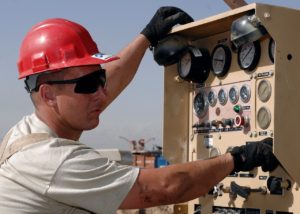 Many people associate work on an oil rig with hardship, isolation and hazard. While oil rigger jobs do have their challenges, they can also be exciting, gratifying and profitable. An oil rig is a man-made platform erected in the ocean many miles from shore for the purpose of drilling for and pumping oil and natural gas. Because of the nature of the work and the rig’s distance from land, the rig may often include sleeping quarters, entertainment and recreation facilities, food service amenities and administrative office space. Some rigs are built high; others, wide. Workers are issued an array of safety gear due to the combustible nature of oil and the complex machinery designed to extract it.
The Roustabout
The roustabout, or roughneck, serves as a basic laborer on an oil rig, providing needed brawn for its daily operations. Although no drilling experience is required for a roustabout position, recruits often complete a month-long training course on the operations, safety and protocols related to work on an energy platform. Moving drilling equipment to a site, rig construction, the many types of drilling (e.g. auger, air core, reverse circulation), extracting core samples and packaging them for geological evaluation are just some of the areas in which roustabouts are assisting. Maintenance of drilling equipment also consumes a large part of the roughneck’s day.
The Rotary Drill Operator
The rotary drill operator has a title that sounds narrow in focus but this employee must be a model multi-tasker. Monitoring the gauges that measure the pressure of the tools in the boreholes, the operator must also decide on how deep those boreholes should go, while simultaneously manipulating the levers and pedals that move the drill pipes and casings. Additionally, the operator must mix clay, water and chemicals in precise proportions to create the drilling mud needed to lubricate and cool the drill bits. Meanwhile, records must be kept with regard to footage drilled, substances penetrated, time consumed and tools used.
The Subsea Engineer
The subsea engineer comes to the rig with the minimum of a bachelor’s degree in engineering. Submerged drills and pumps are easily affected by underwater temperature, pressure and salinity. In order to ensure equipment durability against these agents of corrosion and disrepair, subsea engineers design and sustain the drilling components that maintain structural integrity beneath the surface. Included in this responsibility is the infrastructure that anchors the platform to the ocean floor. Because underwater conditions can change often, the subsea engineer must always be prepared to re-calibrate and make the necessary changes to the rig and the drilling implements.
The Site Geologist
Geologists stationed on oil rigs act as point persons for drilling decisions. Examining the core samples from rock strata, they determine how and where drilling should take place. Comparing acquired data to predictions during the exploration phase, site geologists communicate their findings to onshore geologists for further analysis. They also call operators’ attention to any drilling hazards. Most oil rig geologists have earned a master’s degree at a minimum.
Oil Workers Are Seeing A Decline In Wage Growth
Specific Jobs For A Refinery Shutdown
Three Things Oil Workers Should Know From Senior Oil Managers
About Author
